25 July - 2 September 2022, Australia
Cyber security is the practice of protecting computer systems, infrastructure and data from digital attacks, and it is identified as an important sector for Australia's national security, innovation and prosperity.
Computers communicate through networks such as the Internet, and the communication may be eavesdropped, and the data be manipulated by attackers. Consequently, protecting information from being leaked and manipulated is a major problem in cyber security.
Cryptography is the foundation of cyber security. It includes techniques such as encryption, hashing and digital signatures, which are central to today's network security protocols. These techniques provide confidentiality, data integrity and authenticity for everyday applications.
Before computers, Aboriginal and Torres Strait Islander people had intelligent ways to communicate complex information and knowledge across large distances and different Indigenous languages. Message sticks are used by many Aboriginal and Torres Strait Islander peoples and nations to communicate information. The information is sometimes carved or painted with symbols or designs into the wood to send the message. Sometimes this information is special or protected knowledge for only certain people so it might be harder to understand or de-code the symbols and designs. To protect information digitally we might do something similar to message stick technology to hide information or protect it.
In this challenge, we will learn a variety of cryptography techniques and apply them to solve puzzles and protect information security.
Encryption is a technique for protecting data confidentiality. Suppose Alice wants to send a message to Bob but does not want anybody else to be able to read the message. They can undertake the following steps to communicate securely:
Step 1: Alice and Bob choose an encryption method and a key.
Step 2: When Alice wants to send a message, she uses the encryption method, which takes the key and the message as input and outputs a ciphertext. The ciphertext usually reads like a meaningless text.
Step 3: Then Alice can send the message to Bob without worrying about it being read by others.
Step 4: When Bob receives the message, he decrypts the ciphertext using the key and obtains the original message.
Note that an encryption method usually comes with an associated decryption method. For simplicity, we will call an encryption/decryption method a cipher. In the above steps, the key for encryption and decryption are the same, so we call such methods symmetric ciphers.
Caesar cipher is perhaps the simplest and most widely known cipher. It is named after the Roman general and statesman Julius Caesar (100 BC - 44 BC), who used this method in his private correspondence. The key in Cassar cipher is simply a number between 0 and 25. The encryption method shifts the alphabet by a number of times indicated by the key so that each letter in the original message is mapped to a new letter in the ciphertext.
As an example, if the key is 3, we shift each letter in the English alphabet 3 positions to the right, as shown in the below figure, where the outer ring is the original alphabet, and the inner ring is the new alphabet. In this case, an A becomes a D, a B becomes an E, and so on. Note that we treat an alphabet as a circular list, so if we shift Z 3 positions to the right, we get C. Conversely, if we shift B 3 positions to the left, we get Y.
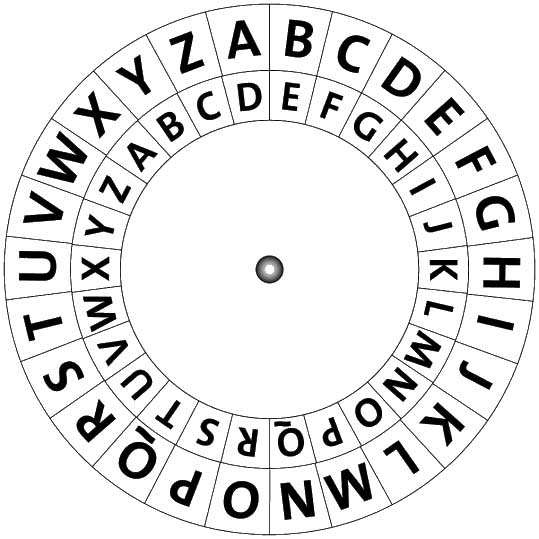
Suppose Alice wants to send the message "SEE YOU AT FIVE PM", the encrypted ciphertext is "VHH BRX DA ILYH SP". When Bob receives the ciphertext, he will map each letter back to the original alphabet, that is, an A becomes an X, a B becomes a Y, and so on. You can also understand it as shifting each letter 3 positions to the left. Then Bob should obtain the original message.
If the key is 0, then we shift each letter 0 times, which means we do not change the alphabet at all. In this case, the ciphertext is the same as the original message.

Touching on the wudjuru, the Leptospermum, we have 83 species here in Australia. In New Zealand they have one. They call it Manuka and they make honey from it. We tend to call ours jelly bush. So, we have jelly bush honey, same-same. But we have 83 different varieties of Leptospermum. The inner bark of the wudjuru has a soft-as-silk inner bark, which is used to line the coolamons that would hold the babies to stop baby rash. Another medicine, this one is fairly exciting… when it come up on my radar, I’d heard it from three different resources and we grow it at our indigenous protected area and it’s the native grape and it’s the known cure for the Death Adder venom. And, so, I’ve seen that on the Sunshine Coast when I was up there on a bush trail, bush tucker trail and with their signage they indicated it. I’ve seen it in a bush tucker man’s book which I picked up from an op shop and then we had our signage at our indigenous protected area and showed that the native grape is, you know, in fact the cure for the Death Adder bite. An old lore man told me, he said, “You wanna know what the medicine is if you’re stung or bitten by something out in the bush?” he said, “You wanna learn? Watch the goanna.” He said, “If the goanna is attacked by a snake or something venomous… that goanna you watch him, where he goes. He’ll go find that medicine.”
Add all the digits of a number in the above text until you get a one-digit number. Use that number to decrypt the below ciphertext.
ejcpig vjg gpf qh vjg ygd rcig nkpm vq dtwvg.jvon
ATSIAP Organiser, Griffith University
l (dot) dickson (at) griffith.edu.au